GULAG Exhibition. Entrance panel. Bordeaux, France.
GULAG
OWNER OF THE EXHIBITION
Tomasz Kizny
CONTACT ADDRESS, TEl, EMAIL, ETC.
Tomasz Kizny Ul. Wieckowskiego 25/19 PL 50-431 Wroclaw Poland kizny@wp.pl
CONTACT PERSON
author: Tomasz Kizny kizny@wp.pl Design and production: Dominique Roynette roynette@noos.fr Tel: +33 6 03 00 05 84
LANGUAGE AND TRANSLATION
The exhibition is available in French, German and Italian.
FINANCIAL CONDITIONS:
The borrowers must pay transportation costs and all other expenses related to translation if necessary, display, dismounting and insurance. The author’s fee will be established by contract. The exhibit is shown under © Tomasz Kizny. The sequence of images must be respected when the venue allows. Otherwise, the author must be informed. Any video and photographic reproduction is prohibited on the exhibition venue.
FORMER EXHIBITION:
Poland (Warsaw), Hungary (Budapest), France (Bordeaux), Italy (Bolzano, Verona).
TECHNICAL REQUIREMENT
84 black and white photographs and 11 color prints, aluminum framed, displayed in 7 chapters.
Panel of entry: 3 rolls 106 x 260 cm to contre-coller 2 rolls 106 x 120 cm to contre-coller
1-SOLOVKI: 6 photographs 66 x 100 cm 3 photographs 100 x 100 cm 6 rolls of 70 x 320 cm to suspend
2 – Belomorkanal: 15 photographs 50 x 75 cm 2 photographs 100 x 150 cm 1 photograph 140 x 140 cm
3 – Vaygach expedition: 2 photographs 90 x 145 cm 2 photographs 100 x 100 cm 4 photographs 60 x 100 cm 7 photographs 50 x 75 cm
4 – Kolyma: 10 photographs 66 x 100 cm 2 photographs 100 x 156 cm 1 photograph 100 x 100 cm
5 – The dead road: 5 photographs 77 x 105 cm 7 photographs 66 x 100 cm 1 photograph 150 x 100 cm
6 – Independent sections: The theater in gulag: 11 color photographs 24 x 30 cm 5 photographs black and white 100 x 100 cm The prisoner Kialka at Vorkouta: 3 photographs black and white 82 x 124 cm
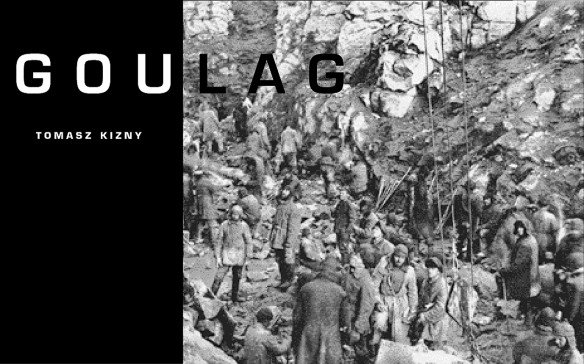
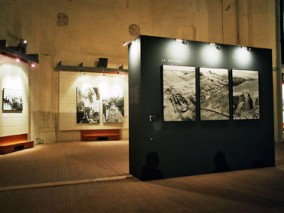
GULAG Exhibition. Bordeaux, France.
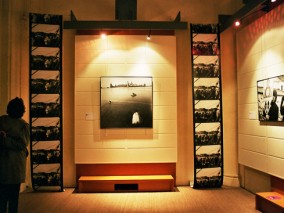
GULAG Exhibition. Bordeaux, France.
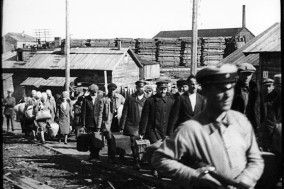
Solovki, 1923-1939. Prisoners on their way from Murmansk railroad station to be sent to the
monastery turned to be a camp on Solovki Islands on the White Sea. The
Solovetski Special Purpose Camp has particular place in the history of
GULAG for since 1929 system of camps started rapidly grow on the
basis of Solovki camp experience. Solovki are also a symbol of the
destruction of Russian tradition and religion by Communism.
The still from soviet propaganda film “Solovki”, dir. A.A. Cherkasov,
“Sovkino” 1928. Rights reserved by Tomasz Kizny Collection.
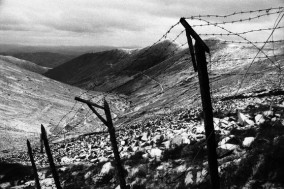
Kolyma. 1931-1955. A tin and uranium ore mine, Butugychag mountain, south-west Kolyma,
the end of the 1940s. Kolyma was one of the harshest places in GULAG. The complex of camps
at Kolyma lying at the northeastern tip of the Soviet Union, was the
biggest prison camp system in the USSR which take in total about 10 per
cent of the territory of the USSR. The main activity was extraction of gold
and later uranium. Author unknown. Rights reserved by Tomasz Kizny Collection.
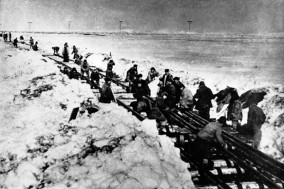
The dead Road. 1947-1953. The prisoners constructing the railroad in tundra, 1947.
The Great Northern Railroad or “The Dead Road” built by 70 000 prisoners was supposed to run 1500 km through Siberia along the Arctic Circle. In two weeks after Stalin's funeral the project was stopped as pointless. By the time almost 900 km had been already constructed. The
construction ended in a total fiasco. Author unknown, still photo from a film. Rights reserved by Tomasz Kizny Collection.
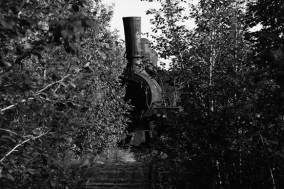
The Dead Road, 1990.
An abandoned locomotive overgrown by the tundra forest. Today the Dead Road is an extraordinary relict of the Gulag: railroad track runs through northern wastelands among the ruins of over a hundred camps; abandoned locomotives are consumed by rust and overgrown by bushes in the bleakness of Siberia. Rights reserved by Tomasz Kizny.
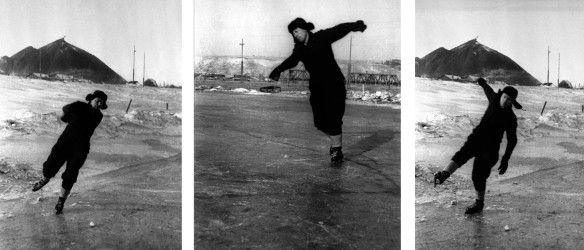
Vorkuta. 1931-1956. Stanislaw Kialka after his release from the camp in Vorkuta 1955; Pole, the anti-Nazi and anti-Soviet armed resistance soldier, in 1945 and sentenced to 15 years in the camps. Vorkuta was a large industrial and camp complex located over 160 km beyond the Arctic Circle. In 1955, an amnesty was proclaimed freeing political prisoners. Released Poles, awaited repatriation took photographs with cameras purchased in the local stores. This unique collection of amateur photographs tells a story of salvation and homecoming. Rights reserved by Stanislaw Kialka / Tomasz Kizny Collection.
ABOUT THE AUTHOR
Tomasz Kizny carried out a long term photographic project entitled “The Gulag” devoted to the system camps in the USSR. The project is an attempt to reveal photographic image of “The Gulag Archipelago” by research in archives, as well as photographing camps remains, post-gulags landscapes and recording eyewitness accounts. The main themes of this work were published in the book Gulag, Paris 2003, Hamburg, Milan, Ontario, Barcelona, 2004 and Moscow 2007.
At present, Tomasz Kizny carries out a similar project devoted to the Great Terror in the USRR 1937-38, the peak of Stalinist repression and crime against humanity which took at least 750,000 deaths toll. The book and exhibition project contains archival documentary photographs and contemporary pictures, taken by author, of the mass graves and soviet killing fields which have been kept top-secret for decades as well as portraits and accounts of the eyewitnesses of the Great Terror.
ABOUT THE EXHIBITION
Gulag or Main Camps Administration was soviet security department that administered vast system of forced-labor camps in the USSR, also responsible for prisons, deportations and “special exiles” (internal banishment). The Gulag evolved into a devastating tool of political suppression and massive industrial production. In period 1930-1956, the total number of camps’ prisoners and exiled passed through the Gulag system is estimated for 28 million and 700 thousands. The death statistics for the Gulag camps and the “special exile” are estimated as 2 million 750 thousand people. (Ann Appelbaum GULAG. A History. 2003).
The Gulag exhibition presents documentary photographs from archives and private collections, as well as photographs of vanishing traces of “camp civilization” impressed on the post-soviet landscapes of Russia. The exhibition is designed in seven chapters bringing detailed historical and photographic account of camps and one chapter on theatre in Gulag:
Solovki – the monastery that was the birthplace of the Gulag system in 1923 and serves as a symbol of the destruction of Russian tradition, religion and culture.
The White Sea Canal – one of the first construction projects which relied exclusively on the forced labor of 100, 000 prisoners and 70, 000 special exiled.
Vaygach Expedition – one of the first Gulag settlements on the Far North beyond the Arctic Circle.
The Kolyma – complex of camps for gold extraction at the northeastern tip of the Soviet Union, the largest camp system in the USSR and one of the harshest places in Gulag.
Vorkuta – large industrial and camp complex for coal extraction located beyond the Arctic Circle. The prisoners’ photographs are telling a story of salvation from camps after Stalin’s death.
The “Dead Road” – never completed railroad in Siberia. The last “great communist construction project” of Stalinist times. Today, an extraordinary relict of the Gulag: 700 km of track among the ruins of over a 100 camps.
Theatre in Gulag – the theatre was very popular in the gulags. Many camp commanders made it a point of pride to have their own theatre group with actors recruited among prisoners. “After the performance, the actors took off their princes’, ladies’ and hussars’ costumes and changed into padded jackets and hats with earflaps. In the gloom of the Arctic night, an armed convoy escorted the conductor, the musicians, actors and dancers behind the barbed wire again. Here the performers went back to their real-life role as prisoners.” Memory of Lazar Sheryshevsky who, as a prisoner, worked in the camps’ theatre.